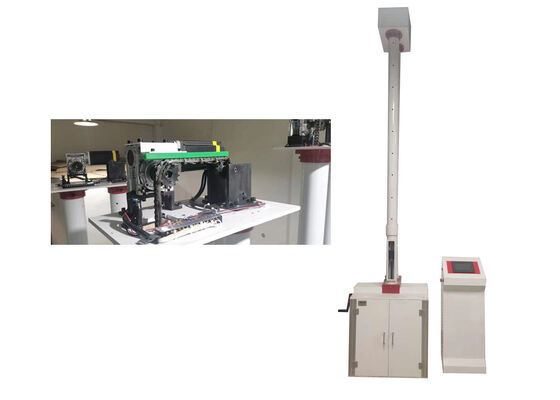
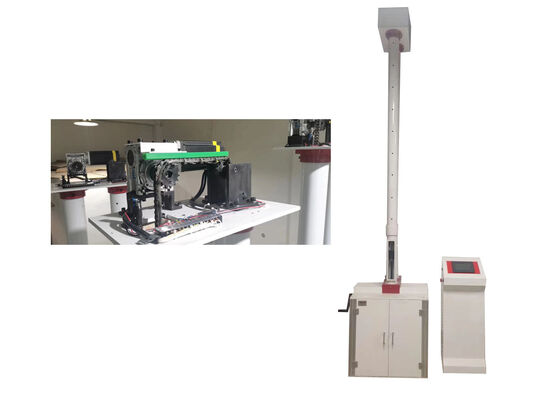
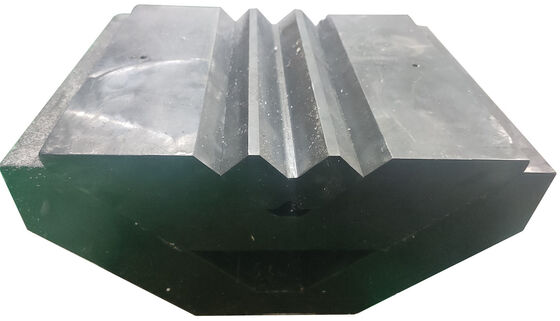
Équipement d'essai à marteaux pour la mesure précise de la résistance à l'impact
Cette machine d'essai est largement utilisée pour tester la résistance à l'impact de la charge externe des tuyaux en plastique, des feuilles en plastique et des matériaux non métalliques.Les spécimens sont frappés par un marteau de chute de masse et de forme spécifiées libéré à une hauteur prédéfinie sur des positions désignées le long de la circonférence de l'échantillon.Ce procédé permet d'estimer avec précision le taux d'impact réel (TIR) pour le lot de produit ou la production de l'extrudeuse.
Règlement TIR maximal admissible10% (alignés sur les normes de contrôle de la qualité de l'industrie)
En tant qu'instrument professionnel d'inspection de la qualité, il est largement appliqué dans l'industrie de la construction, les entreprises manufacturières, le secteur chimique, les universités,et autres institutions de R&D ou de contrôle de la qualité.
Normes de conformité
Les données sont fournies par les autorités compétentes.1, GB/T5836.1, GB/T13664, GB/T16800, ASTM D2444, ISO4422, ISO3127, BSEN1411 et BSEN744; ou
Caractéristiques de l'équipement
Système de protection de sécurité à trois niveaux
- Niveau 1: échantillon de garde de sécurité de porte de chambre
- Niveau 2: Protection de sécurité des fenêtres d'observation (temporairement non équipées)
- Niveau 3: Mécanisme de sécurité des limites de déplacement supérieures et inférieures
Cette protection à plusieurs niveaux garantit la sécurité de l'opérateur et du spécimen tout au long du cycle d'essai.
Capacité de levage à grande vitesse
Équipé d'un moteur pas à pas à couple élevé, l'appareil atteint une vitesse de levage maximale de 250 mm/s. Il peut soulever le marteau de zéro au sol à 2 mètres en seulement 8 secondes.Réduction drastique du temps de cycle d'essai et amélioration de l'efficacité globale.
Système de survol de précision
En utilisant un programme de régulation de vitesse en plusieurs étapes, la machine assure un positionnement du marteau en douceur et en précision avec un décalage nul.fournir des résultats fiables et reproductibles.
Tubes de marteau à goutte améliorées avec structure d'échappement
Le tube de marteau est conçu par modélisation 3D, intégré avec des trous de ventilation pour réduire au minimum la résistance au vent pendant la descente du marteau.Il intègre également un mécanisme de serrage renforcé pour éviter la déformation du tube ou une panne fonctionnelle, assurant une robustesse opérationnelle à long terme.
Mécanisme de fixation et de relâchement du marteau pneumatique
En remplacement des réglages de marteaux électromagnétiques conventionnels, le système adopte une configuration pneumatique haute pression équipée d'un double cylindre à longue course de 300 N.La face du marteau est équipée d'un tampon tendon en caoutchoucLes deux fonctions de serrage et de relâchement tirent parti de la technologie pneumatique, résolvant fondamentalement des problèmes tels que l'usure du câble, la rupture du fil,et fuite électriqueLe dispositif de verrouillage automatique pneumatique intégré assure un fonctionnement sûr et fiable.
Architecture modulaire intégrée
- Unité mécanique:Utilise une construction de profil en alliage d'aluminium standard, permettant des processus standardisés, une installation modulaire, une conception légère et une rigidité structurelle élevée.
- Unité de commande électrique:Il est configuré avec un écran tactile de 7 pouces et Delta PLC, facilitant un fonctionnement convivial, des performances de contrôle stables et une maintenance simple.
Sélection de composants de haute qualité
Tous les composants de base sont achetés dans le monde entier pour une fiabilité et des performances supérieures:
- Cylindre de la marque Adker
- Écran tactile: marque Delta
- PLC: marque Delta
- L'alimentation électrique: marque Mean Well (Taiwan, Chine)
La machine est équipée de mesures de sécurité complètes, y compris la protection contre les fuites électriques, la prévention du court-circuit, les mesures antistatiques, la technologie anti-interférence,protection contre les pannes de courant, et la prévention des dysfonctionnements, couvrant les aspects électriques, mécaniques et logiciels.
Capacité d'automatisation avancée
L'instrument dispose d'une automatisation de bout en bout, comprenant l'étalonnage automatique du point zéro, l'élévation automatique du marteau, le relâchement automatique du marteau et l'exécution automatique du test.Cela réduit la participation manuelle, améliore l'efficacité des tests et atténue les erreurs humaines.
Paramètres techniques
| Paramètre |
Spécification |
| Modèle |
Le XJL-450M |
| Température ambiante |
10°C à 35°C |
| Qualité du marteau |
0.5kg à 5kg |
| Diamètre du marteau |
D25 mm, D90 mm (personnalisable) |
| Hauteur de la chute |
50 mm à 2000 mm, erreur ≤ ± 2 mm |
| Diamètre de l'échantillon |
Φ10 mm-Φ450 mm (personnalisable) |
| Déviation du centre d'impact par rapport au centre de l'appareil |
≤ 2 mm |
| Support de type V |
120° |
| Source de puissance |
220VAC ± 10% |
| Dimension du contour |
730 mm*700 mm*3650 mm |
| Poids net |
300 kg ou plus |
Configuration standard
| Composant |
Quantité |
| Hôte |
Un ensemble |
| Armoire électrique |
Un ensemble |
| Le corps du marteau |
Un ensemble |
| Lignes électriques |
Une seule pièce. |
| Support de type V |
Deux pièces. |
| Outil d'exploitation (clé) |
Un ensemble |
Questions fréquemment posées
Q1: Quelle est la plage maximale d'énergie d'impact de la machine d'essai d'impact au marteau à goutte à goutte?
R1: Le modèle standard offre une plage d'énergie d'impact de 0,5 à 50 J, avec des extensions optionnelles à 100 J pour les essais de matériaux à haute résistance.Il prend en charge des niveaux d'énergie réglables pour répondre aux diverses exigences de test pour les tuyaux en plastique, feuilles et matériaux non métalliques.
Q2: Quelles sont les hauteurs de chute disponibles et les spécifications de masse du marteau?
R2: La hauteur de chute réglable varie de 50 à 2000 mm (de précision à ± 1 mm).2 kg à 10 kg, couvrant des normes d'essai communes telles que ISO 3127 et ASTM D 2444.
Q3: Quelle est la précision du contrôle de la hauteur de chute et de la force d'impact de la machine?
A3: la précision de la hauteur de chute est de ±0,1% de la valeur définie (ou de ±1 mm, selon la valeur inférieure); le mécanisme de relâchement pneumatique assure une déviation de vitesse initiale nulle,tandis que le système de détection de la force (facultatif) fournit une précision de la force d'impact de ± 1% FS garantissant la fiabilité des données d'essai.
Q4: Quels sont les mécanismes de protection de la sécurité dont dispose la machine pour prévenir les risques opérationnels?
A4: Il est équipé d'un système de sécurité à trois niveaux: 1 blocage de la chambre d'échantillonnage (la machine s'arrête si la porte est ouverte); 2 interrupteurs de limite de déplacement supérieure/inférieure; 3 bouton d'arrêt d'urgence.Le tube du marteau de chute est également renforcé pour éviter les dommages structurels lors d'impacts à haute énergie.
Q5: La machine est-elle compatible avec les normes internationales d'essai et quels matériaux peut-elle tester?
A5: Il est entièrement conforme aux normes ISO 3127, ASTM D 2444, GB/T 14152 et BS EN 14411.et autres matériaux nécessitant une évaluation de la résistance à l'impact externe.
Q6: Quel est le niveau d'automatisation de la machine et peut-elle enregistrer automatiquement les données d'essai?
A6: Il prend en charge l'automatisation complète du processus: étalonnage automatique au point zéro, levage du marteau, positionnement, relâchement et calcul des résultats de l'essai.il peut stocker jusqu'à 10,000 enregistrements d'essais (y compris l'énergie d'impact, la hauteur de chute, la valeur TIR) et les données d'exportation au format Excel/CSV.
Q7: Quelle est la durée de vie des composants clés et quelle maintenance est requise?
A7: Les composants de base (cylindre pneumatique, moteur pas à pas, PLC) ont une durée de vie de ≥ 50 000 cycles d'essai.inspection trimestrielle de l'anneau de scellement, et un étalonnage annuel de la hauteur de chute et de la masse du marteau.
Q8: Quelles sont les conditions environnementales requises pour que la machine fonctionne normalement?
A8: température de fonctionnement: 10 à 35 °C; humidité relative: ≤ 85% (sans condensation); alimentation en courant alternatif: 220 V ± 10% 50 Hz (ou 110 V ± 10% 60 Hz, personnalisable);aucune interférence électromagnétique ou vibration forte dans la zone de travail.



 Votre message doit contenir entre 20 et 3 000 caractères!